Shopify's AI-powered app review catches bugs before launch: Who's catching bugs after?

On April 20, 2026, Shopify rolled out a significant upgrade to its Partner Dashboard: an AI-powered self-review tool that checks apps against App Store requirements before submission. The new system includes automated pre-submission checks, requirement-level tracking with individual status indicators, and a structured fix workflow that blocks resubmission until every identified issue is resolved.
It's a smart move. The old email-based review process was slow and opaque. Developers would submit an app, wait weeks, and then get bounced back for issues they could have caught in minutes. The new system reportedly takes just two minutes to flag the obvious problems, theme app extension requirements, listing compliance, API usage patterns, saving developers and Shopify's review team enormous amounts of time.
But here's the question this raises for every eCommerce team: If pre-launch quality assurance is getting this level of attention, what happens to quality assurance after launch?
The pre-launch or post-launch disconnect
Shopify's investment in AI-powered pre-submission checks reflects a broader industry recognition: catching issues early is exponentially cheaper than catching them later. This is a well-understood principle in software engineering. What's less well-understood, especially in eCommerce, is that the same principle applies to live production sites.
Consider the data: the Baymard Institute's latest research puts the average cart abandonment rate at 70%, and a consistent finding across multiple studies is that roughly 15% of shoppers abandon their purchase specifically because of website errors and crashes. That translates to real revenue loss. According to research from the Retail Technology Innovation Hub, online retailers lose an estimated $18 billion annually from abandoned carts, with the projected value of merchandise sitting in online carts reaching $4 trillion per year.
The apps that pass Shopify's shiny new AI review process on day one will eventually develop issues in production. Third-party integrations break. API changes ripple through checkout flows. Payment gateways timeout during peak traffic. A JavaScript error on a product page silently prevents an add-to-cart button from functioning.
The invisible revenue leak
What makes post-launch site errors so insidious is their invisibility. Research consistently shows that the vast majority of bugs on eCommerce sites go unreported by customers. Shoppers don't file bug reports; they just leave. They hit a broken checkout flow, a page that won't load, or a button that doesn't respond, and they navigate to a competitor.
This is the fundamental gap in most eCommerce monitoring strategies. Teams invest heavily in pre-launch testing, unit tests, staging environments, QA sprints, and Shopify's new tools make pre-submission checks even more robust. But once the app or storefront is live, visibility drops dramatically.
Traditional application performance monitoring (APM) tools can tell you that a server responded in 200 milliseconds. They can't tell you that a customer in Melbourne on a 4G connection saw a layout shift that pushed the "Add to Cart" button below the fold, or that a third-party review widget threw an uncaught JavaScript error that broke the checkout on Safari.
Real user monitoring fills the gap
This is where real user monitoring (RUM) becomes essential, and where AuditIQ fits into the picture. Rather than relying on synthetic tests that simulate ideal conditions, AuditIQ monitors what real users actually experience on your live eCommerce site. Every page load, every interaction, every error, captured from the perspective of the people who are actually trying to buy from you.
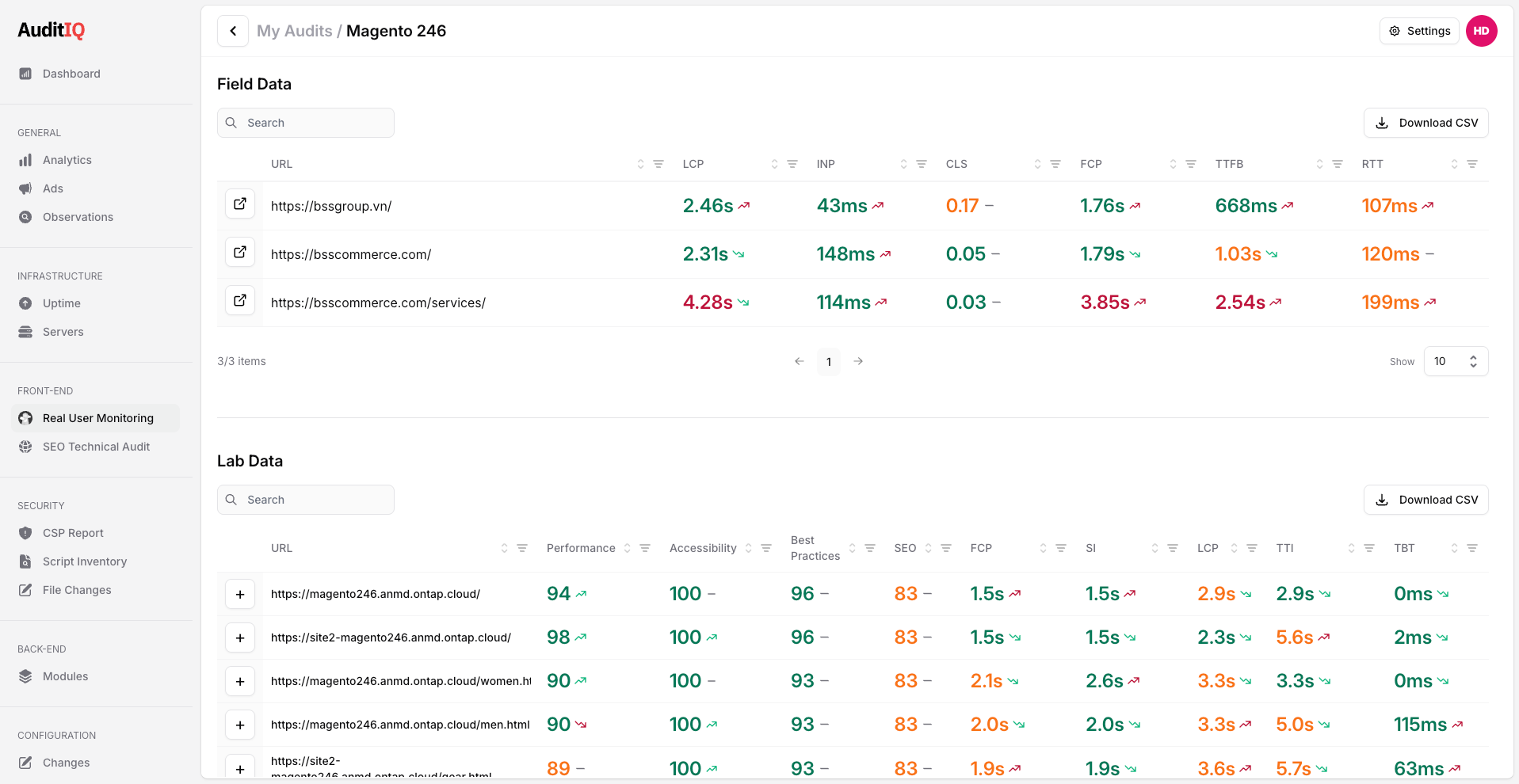
AuditIQ’s real user monitoring
When Shopify releases API version 2026-04 with new fields like isActive on InventoryLevel and the includeInactive argument for inventory queries, both of which shipped this same week, those changes can have downstream effects on apps and custom storefronts. An app that worked perfectly under the old API might exhibit subtle bugs with the new one. Without production monitoring, those bugs won't surface until a merchant notices their conversion rate has dropped and starts investigating.
AuditIQ catches these issues as they happen. It correlates frontend errors with the pages and user journeys where they occur, quantifies the revenue impact, and prioritises fixes based on business outcomes rather than technical severity scores. A JavaScript error on a rarely-visited FAQ page is very different from a JavaScript error on your checkout page, and AuditIQ knows the difference.
What the Shopify ecosystem should take away
Shopify's new AI-powered submission tools are genuinely useful. They'll reduce review cycles, improve app quality at launch, and make the ecosystem better for merchants. But they address only half the quality equation.
The other half, continuous monitoring of live production sites, is where most eCommerce teams still have a blind spot. And with Shopify's API continuing to evolve rapidly (the April 2026 release alone includes inventory API changes, payment app mTLS certificate renewals, and new collection sort options), the surface area for post-deployment issues is growing.
If you're building or managing a Shopify store, the lesson from this week's releases is clear: invest in catching problems before they go live, and invest equally in catching the problems that only appear once real customers are interacting with your site.
AuditIQ gives you that post-launch visibility. It monitors your live eCommerce site from your customers' perspective, catches errors and performance issues in real time, and helps you fix what matters most, before it costs you revenue. Monitor your store with AuditIQ now!
About the author
Dan Garner writes from AuditIQ's experience monitoring eCommerce performance, SEO, security, and reliability issues across Magento, Shopify, WooCommerce, and Adobe Commerce stores.