Shopify just opened Checkout Blocks to every plan: Why error monitoring matters more than ever

Shopify's April 2026 changelog is packed with changes that democratise powerful features previously reserved for Plus merchants. Checkout Blocks, including order value limits, are now available on Basic, Grow, and Advanced plans. Native B2B features like company profiles, custom catalogues, and payment terms have followed the same path. And a revamped analytics insights panel now surfaces conversion-rate trends directly in the Home feed for shops processing as little as ten orders per week.
These are welcome moves. They give every Shopify merchant the building blocks of an enterprise-grade storefront. But there's a catch that rarely makes it into the changelog: the more complexity you add to checkout, the more surface area you create for things to break.
The checkout complexity trap
According to the Baymard Institute's 2026 dataset, the average cart abandonment rate sits at 70.22%. Among the reasons shoppers cite, 15% point directly to website errors and crashes. That might sound modest until you do the arithmetic on a store processing $500K per month; 15% of lost conversions to technical issues can quietly drain five figures of revenue every quarter.
Industry benchmarking data from Holiday 2025 reinforces the point. Across major eCommerce brands, 41.2 billion error events were recorded during the peak shopping season, exposing an estimated $2.9 billion in revenue pathways to friction.
The biggest revenue leaks weren't full-blown outages. They were micro-failures: a checkout script that throws an exception on one browser version, a payment gateway timeout that occurs only under load, or a third-party app that injects a conflict after a platform update.
Why this Shopify update amplifies the risk
When Checkout Blocks were a Plus-only feature, the merchants using them typically had dedicated engineering teams and QA processes. Now that any Shopify merchant can enforce minimum order values, customise checkout UI, and layer in B2B payment terms, the population of stores running complex checkout logic is about to expand dramatically, without a corresponding expansion in technical oversight.
Consider what a typical Basic-plan merchant might now configure:
- Checkout Blocks with order-value limits and conditional UI rules
- B2B payment terms for wholesale customers alongside DTC checkout
- Third-party apps for reviews, loyalty, and upsells, each injecting scripts into the checkout flow
- Analytics tracking via the new insights panel, which itself relies on correct event firing
Every one of these layers is a potential failure point. A JavaScript error in a checkout extension can silently prevent the "Complete Order" button from responding. A misconfigured payment-terms rule can display the wrong options to a logged-in B2B customer. And when these errors occur only for specific user segments or device types, they're almost impossible to catch with manual testing.
What the Smashing Magazine UX conversation tells us
This week, Smashing Magazine published a thought-provoking piece, "The UX Designer's Nightmare: When 'Production-Ready' Becomes A Design Deliverable", exploring the blurring line between design and engineering as AI accelerates the production pipeline. The core argument is that when teams rush from design to deployment, the guardianship of user experience can fall through the cracks.
The parallel to eCommerce is direct. Shopify has made it easier than ever to go from idea to live checkout customisation. But "easier to deploy" doesn't mean "easier to maintain." The merchants who will thrive are those who treat their live storefront as a product that needs continuous monitoring, not just periodic manual review.
How AuditIQ closes the gap
This is precisely the problem AuditIQ was built to solve. AuditIQ provides continuous, real-user monitoring purpose-built for eCommerce storefronts. Rather than relying on synthetic tests that simulate an idealised checkout flow, AuditIQ captures what real shoppers experience, across every browser, device, and network condition.
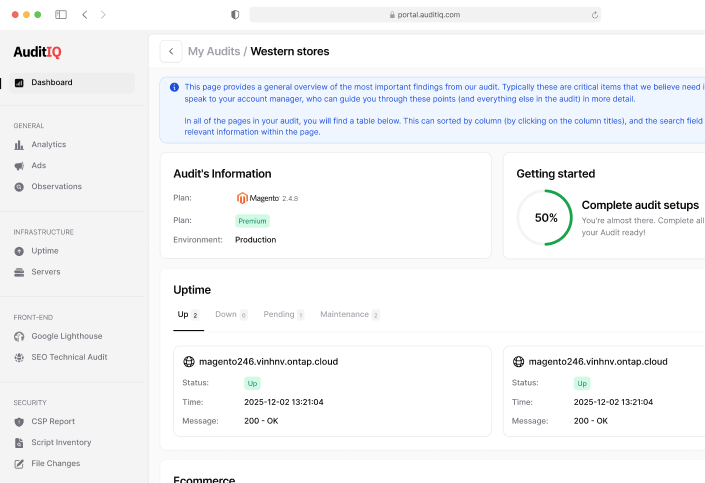
AuditIQ user experience monitoring
Here's what that means in practice for a Shopify merchant who's just enabled Checkout Blocks:
- Instant error detection: When a checkout extension throws a JavaScript error, AuditIQ flags it within minutes, not after a week of declining conversion rates and a support ticket from a frustrated customer.
- Revenue-impact prioritisation: Not all errors are equal. AuditIQ correlates errors with cart value and checkout stage, so your team fixes the $50,000 problem before the $50 one.
- Platform-aware context: AuditIQ understands the Shopify ecosystem. It distinguishes between errors originating in your theme, your apps, and Shopify's own infrastructure, so you know exactly where to direct the fix.
- Core Web Vitals tracking: With research showing that reducing Largest Contentful Paint from 2.5 seconds to 1.3 seconds can lift conversion rates by nearly 50%, performance monitoring isn't optional. AuditIQ tracks LCP, INP, and CLS for every real session.
The bottom line
Shopify's move to open Checkout Blocks and B2B features to every plan is genuinely empowering. But power without visibility is a liability. The stores that win won't just be the ones with the most sophisticated checkout; they'll be the ones that know, in real time, when that checkout breaks.
If you're a Shopify merchant adding complexity to your checkout flow, now is the time to add monitoring alongside it. Learn how AuditIQ keeps your checkout performing.
About the author
Dan Garner writes from AuditIQ's experience monitoring eCommerce performance, SEO, security, and reliability issues across Magento, Shopify, WooCommerce, and Adobe Commerce stores.