Shopify's CSS Subsetting is a performance win: Are you catching the errors it can't fix?

On April 23, Shopify announced a significant storefront performance optimisation: automatic CSS content subsetting for {% stylesheet %} tags. The platform will now intelligently split and serve only the CSS a page actually needs, reducing payload sizes and improving load times across all Shopify storefronts.
It's a smart, infrastructure-level change, the kind that lifts every store's baseline performance without merchants needing to lift a finger. And it comes alongside a week packed with developer-facing updates, including the new Universal Commerce Protocol (UCP) integration for the Storefront Catalogue MCP server and expanded analytics capabilities like multi-metric charting and the new MATCHES operator in ShopifyQL.
But here's the question every eCommerce team should be asking: when Shopify changes how your CSS is delivered, how will you know if something breaks?
The performance-fragility paradox
Platform-level performance improvements are welcome. Every 100-millisecond improvement in page load time can boost conversion rates by up to 7%, according to multiple industry studies. Sites that reduce their Largest Contentful Paint (LCP) from 2.5 seconds to 1.3 seconds see conversion rates rise from 1.50% to 2.25%, a nearly 50% relative lift.
But infrastructure changes also introduce risk. CSS subsetting means your stylesheets are being algorithmically split. If the subsetting logic misclassifies a critical rule, say, the styles that render your "Add to Cart" button, your checkout form validation highlights, or your payment method selector, the visual result could be a perfectly-loading page that looks broken to specific user segments.
And here's the uncomfortable truth that recent research makes painfully clear: 90% of critical website errors are never reported by customers. They just leave. A recent analysis found that hidden website errors silently cost eCommerce retailers between 3% and 5% of their annual gross merchandise value. For a store doing $10 million in annual revenue, that's $300,000 to $500,000 quietly evaporating.
Your risk compounds daily because Shopify ships every week
Shopify's CSS subsetting update is just one example of a broader pattern. eCommerce platforms are constantly shipping optimisations, API changes, and infrastructure updates. In the past week alone, Shopify also rolled out:
- Checkout Blocks order value limits on all plans (previously Plus-only), changing checkout behaviour for thousands of stores
- Updated local pickup UX in checkout, altering a flow that customers navigate during the final, most critical stage of conversion
- Customer default address management in checkout, another change to the authenticated checkout experience
Each of these is individually beneficial. Collectively, they represent a constant stream of change to the most revenue-sensitive part of your store. And each change is a potential source of browser-specific, device-specific, or region-specific regressions that only real user monitoring can catch.
The monitoring gap becomes obvious
The challenge isn't that Shopify is doing something wrong; CSS subsetting is a genuinely good optimisation. The challenge is that most eCommerce teams lack the visibility to detect when any platform change creates unintended side effects for real users.
Consider the typical monitoring setup: a developer checks the homepage on their MacBook, confirms everything looks fine, and moves on. Meanwhile:
- A customer on an older Android device using Chrome 109 encounters a checkout page where the payment buttons have lost their styling
- A shopper in a region served by a different CDN edge node gets a subsetting split that misses critical form CSS
- A user on Safari with an unusual viewport width sees a layout shift that pushes the checkout button below the fold
These are the "micro-outages" that traditional monitoring completely misses. They don't trigger server errors. They don't show up in your APM dashboards. They're invisible to everyone except the customers who experience them, and those customers simply abandon their carts and shop elsewhere.
Industry data backs this up: checkout abandonment rates now sit at 70.22%, with 15% of abandoners citing overly complex or broken checkout processes as their reason for leaving. When technical issues compound the inherent friction of the checkout flow, the revenue impact is severe.
Where AuditIQ fits
This is exactly the problem AuditIQ was built to solve. Rather than relying on synthetic tests that check a handful of happy paths, AuditIQ monitors your live eCommerce site from the perspective of actual users, across real browsers, real devices, and real network conditions.
When Shopify ships a change like CSS subsetting, AuditIQ detects the downstream effects on your storefront in real time:
- Visual regressions that affect specific browser-device combinations
- Checkout flow breakages that only manifest under certain conditions
- Performance degradations that slip through platform-level optimisations
- JavaScript errors triggered by changed CSS load ordering
Instead of waiting for customers to report problems (which, remember, 90% won't do), AuditIQ surfaces issues the moment they begin affecting real sessions, prioritised by revenue impact so your team knows exactly what to fix first.
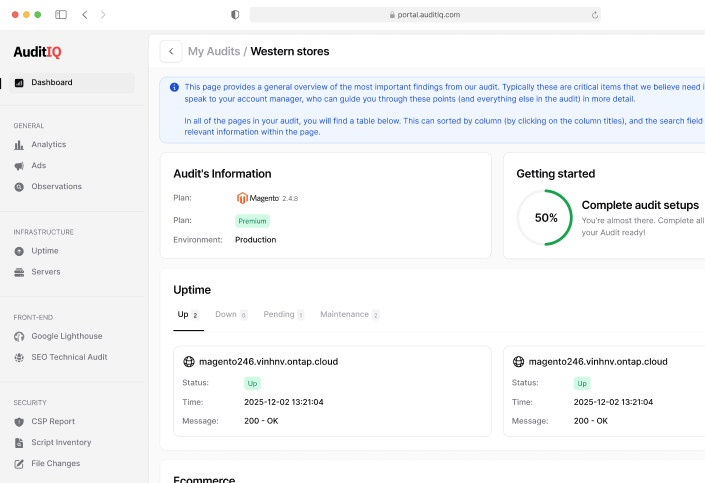
AuditIQ user experience monitoring
The bottom line
Shopify's CSS subsetting is a welcome performance win. But in eCommerce, every change, even a beneficial one, is a potential source of hidden errors that quietly drain revenue. The stores that thrive aren't just the ones on the best platforms; they're the ones with the visibility to catch what falls through the cracks.
Don't let platform changes become silent revenue leaks. Learn how AuditIQ gives you real-time visibility into the errors your customers won't report.
About the author
Dan Garner writes from AuditIQ's experience monitoring eCommerce performance, SEO, security, and reliability issues across Magento, Shopify, WooCommerce, and Adobe Commerce stores.