Shopify's new bot rate limits are a wake-up call: Is your storefront silently breaking for real customers?
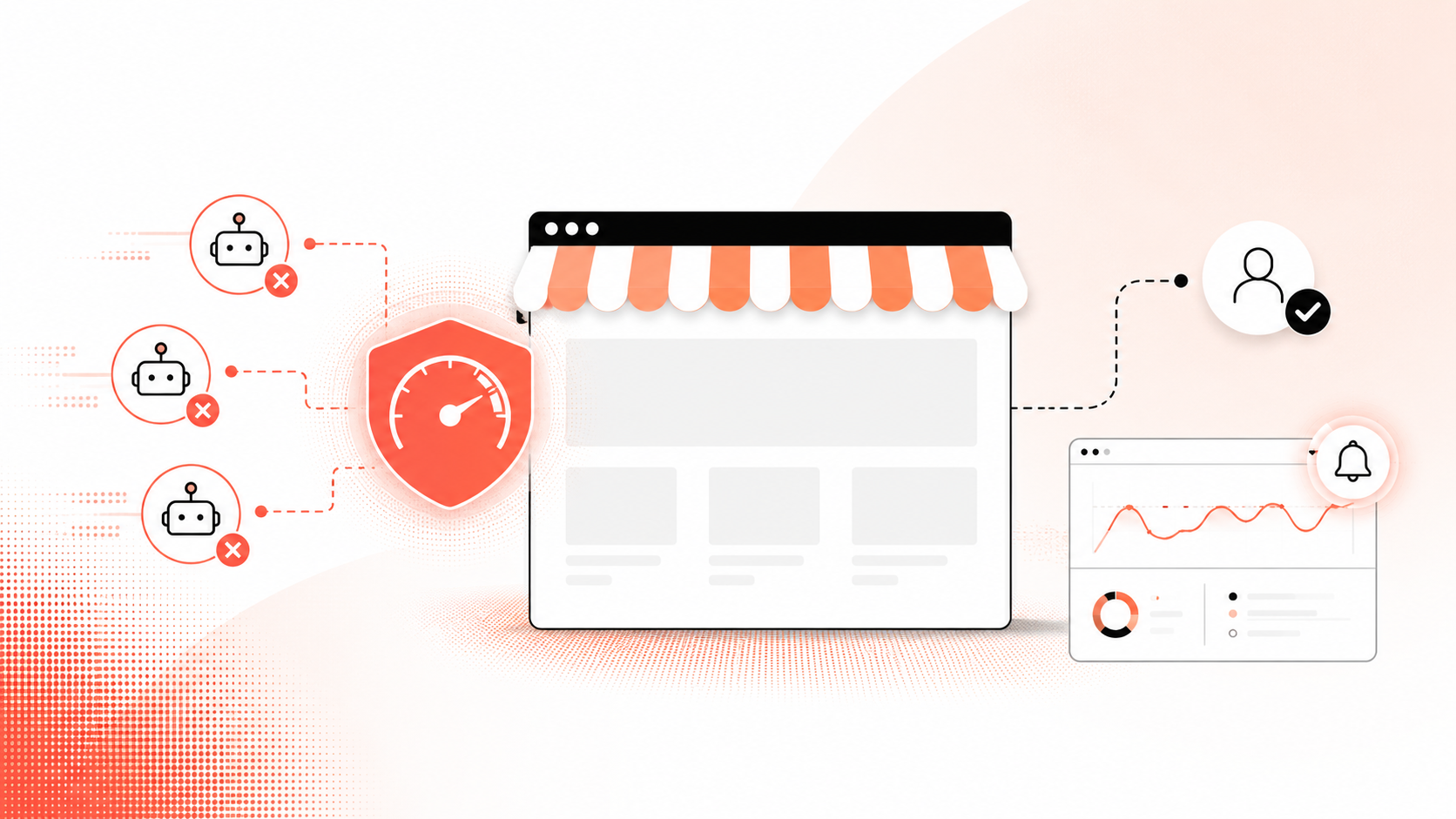
On May 7, 2026, Shopify rolled out a significant platform change: stricter rate limits for bots and agents accessing the Storefront API and Shopify-hosted store pages. Bots that don't authenticate via Web Bot Auth now face the harshest throttling. It's a sensible move to protect merchant performance, but it raises an urgent question that most store owners aren't asking: how do you actually know when your storefront is breaking for real users?
What Shopify changed, and why it matters
Think of your Shopify store like a physical shop. Every day, hundreds of “visitors” come through the door, but not all of them are real customers. Many are automated programs, or “bots”: scripts that check your prices, copy your product descriptions, test your inventory levels, or simply flood your entrance and slow everything down for actual shoppers.
Shopify has now decided: bots that want access must show a pass. That pass is called Web Bot Auth, a digital credential that identifies an automated tool as legitimate. Bots with the pass get through normally. Bots without it get throttled: slowed down, limited, or blocked entirely.
The new policy targets automated traffic, crawlers, AI agents, price scrapers, and integration bots that hit Shopify storefronts without identifying themselves. Unsigned bot requests now get the strictest rate limits, while those using the new Web Bot Auth protocol receive more generous thresholds.
Adding to the complexity, Shopify simultaneously released another major API change on May 7: ProductVariant is now a Publishable resource in API version 2026-07. Think of it as a finer-grained on/off switch for each size, colour, or configuration of your products across different sales channels. Merchants and apps can now publish or unpublish individual product variants per sales channel, without deleting variants, duplicating products, or hiding them through storefront code.
This is powerful functionality. But it also means more moving parts. More API calls. More webhook events. More opportunities for a misconfigured integration to silently hide variants from customers or expose them prematurely. When a variant isn’t visible on a specific channel, is that intentional? Or is it a bug in a newly updated app that hasn't properly implemented the resourcePublicationsv2 interface?
For merchants, both changes are a double-edged sword. On the one hand, they should improve performance and give you more control. On the other hand, they introduce new failure modes: any third-party integration, feed syncing tool, or headless commerce layer that accesses your storefront programmatically could suddenly start failing if it hasn’t been updated. A new variant publishing configuration that looks correct might quietly hide your best-selling SKUs from an entire sales channel.
And here’s the uncomfortable truth: you probably won’t notice when it breaks.
The 90% problem: Errors that never get reported
Here’s what makes this especially dangerous for store owners: when something breaks, your customers don’t tell you. They just leave.
Industry research consistently shows that approximately 90% of critical eCommerce site errors are never reported by customers. When a shopper encounters a broken checkout, a product page that won't load, or a payment method that fails, they don't call support; they leave. They go to a competitor. They move on.
According to recent data from the eCommerce Coffee Break podcast, hidden website errors silently cost eCommerce retailers between 3-5% of their annual gross merchandise value. For a store doing $10 million annually, that's $300,000 to $500,000 in revenue evaporating without a trace.
The Shopify bot auth change is a perfect example of how these invisible failures emerge. A third-party app that syncs inventory? It might start getting rate-limited. A headless frontend that calls the Storefront API? Requests could silently fail for certain operations. A price comparison bot that drives referral traffic? Throttled into irrelevance.
None of these will generate an error page, which you can see by refreshing your store on your laptop.
Micro-outages: The revenue killer you can't see
It gets worse. The most damaging failures aren’t the ones that take your whole store down; those you’d notice immediately. The truly dangerous ones are what’s called “micro-outages”: failures that only affect a specific combination of device, browser, and location. Your site might work perfectly for you, sitting at your desk on Chrome with a fast connection, while simultaneously:
- Mobile Safari users in a specific region encounter a JavaScript error that freezes checkout
- A payment gateway integration fails intermittently for Apple Pay on certain device models
- Product images don't load on slower connections because a CDN edge node is misconfigured
- Third-party scripts conflict with each other, causing the add-to-cart button to become unresponsive
These aren't hypothetical scenarios. Baymard Institute's 2026 cart abandonment research shows that 7% of shoppers abandon their carts specifically because of website errors and crashes. Combined with the 18% who leave due to "long and complicated" checkout processes (which often means the checkout is technically broken rather than poorly designed), we're looking at nearly a third of abandonment being influenced by technical failures.
From reactive to proactive: What this means for your store
The pattern here is clear. eCommerce platforms are evolving rapidly, shipping complex, powerful features every week. Each change creates new surface area for things to go wrong. And traditional monitoring approaches (checking your own site, reading support tickets, watching server uptime dashboards) miss the vast majority of real-world customer-facing issues.
What eCommerce teams need is real user monitoring, not synthetic tests that check whether your site loads from a single location, but continuous observation of actual customer sessions across every device, browser, geography, and user flow.
This is precisely what AuditIQ is built to do. AuditIQ monitors your live eCommerce site from the perspective of real users, catching the micro-outages, JavaScript errors, broken checkout flows, and integration failures that your team would never discover through manual testing or traditional server monitoring.
When Shopify ships a change like the bot rate limit update, AuditIQ helps you answer the questions that matter: Are your integrations still working? Are real customers completing checkout successfully? Is that new variant publishing feature behaving as expected across all your sales channels?
Don't wait for the revenue leak to show up in your P&L
The gap between "everything looks fine on my screen" and "customers are silently abandoning because something is broken" is where revenue goes to die. Shopify's continued platform evolution, which, to be clear, is generally excellent for merchants, means that the gap is only going to widen.
If you're managing a Shopify store (or any eCommerce site), the question isn't whether hidden errors are costing you money. It's how much.
Discover how AuditIQ gives you real-time visibility into what your customers actually experience today.
About the author
Dan Garner writes from AuditIQ's experience monitoring eCommerce performance, SEO, security, and reliability issues across Magento, Shopify, WooCommerce, and Adobe Commerce stores.